
01 · Members
Member management that respects privacy.
Rosters, renewals, and role-based access so a treasurer sees dues, an inspector sees hives, and members see only themselves.
For beekeeping associations, beekeepers & researchers
The operating system for beekeeping associations — member rosters, dues tracking, hive registries, inspections, and education in one calm, modern workspace built for backyard groups, county chapters, and statewide associations.
Built with sideline & commercial keepers
A new category
Member software is generic. Hive software is solo. ApiaryBase is the first system that holds both — the people running the association and the colonies they're keeping — so the data your board collects feeds the research your members rely on.
Six pillars
Every association we've talked to is duct-taping the same six things: a member list, a hive registry, inspection records, dues tracking, an event calendar, and a way to share research. ApiaryBase is purpose-built for those six — and nothing else gets in the way.
01 · Members
Rosters, renewals, and role-based access so a treasurer sees dues, an inspector sees hives, and members see only themselves.
02 · Apiary
Geotagged yards, queen records & breed tracking, and a permanent record per colony. Members keep their own data — private to each beekeeper, invisible even to club officers.
03 · Inspections
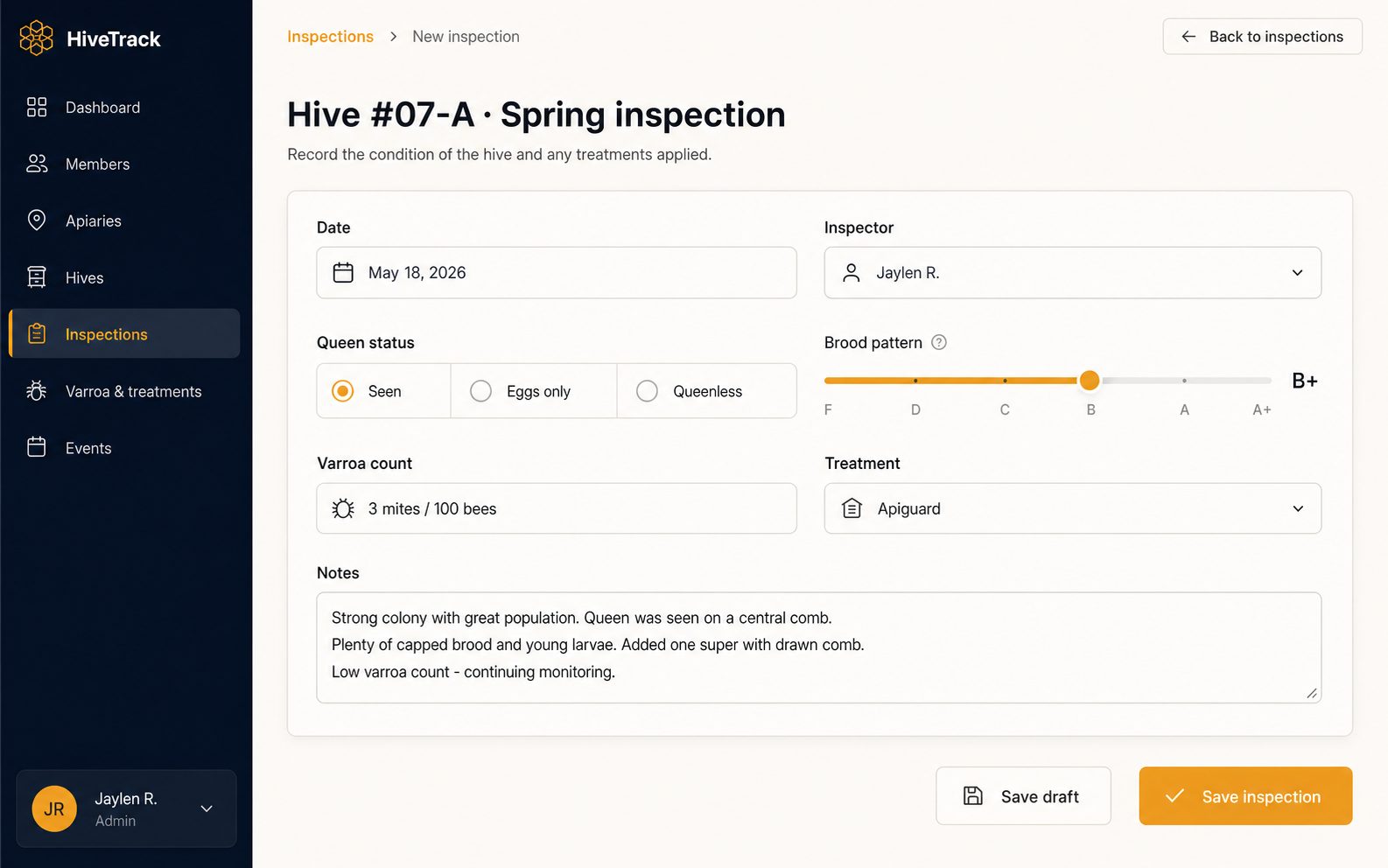
Mobile-first inspection forms with brood pattern scoring, varroa counts, treatment logs, and weather — pre-filled from your last visit so you only record what changed.
04 · Dues
Dues tracking with tiered dues and multi-year memberships — plus automated renewal reminders so your secretary never has to nag. Payments themselves stay between the association and the member.
05 · Events
A real calendar with event RSVPs and announcements, so the meeting schedule lives in one place your members actually visit.
06 · Research
Anonymized loss & treatment data, summed per ZIP code — never an individual beekeeper's records — formatted for BIP, USDA NASS, and university partners.
Anchor feature
Spreadsheets ask everything every time. ApiaryBase asks what changed. Your hive's last queen status, brood pattern, varroa count, and treatment are pre-filled — so a yard of twelve hives is a five-minute walk, not a Sunday afternoon.
Who it's for
ApiaryBase scales from a county group running a single yard to a statewide association coordinating hundreds of beekeepers and dozens of bee schools.
Tier one
The five-to-fifty member group whose secretary is keeping the roster in Google Sheets and the dues in a shoebox.
Tier two
The 200-to-2,000 member organization running bee school cohorts and an annual conference.
Tier three
The keeper running 40, 400, or 4,000 colonies who needs the same records — inspection logs, treatments, and queen tracking across every yard.
Research integration
Every inspection your members record is, with their consent, contributable to the research that decides what we know about colony loss, varroa pressure, and treatment efficacy. ApiaryBase ships with formats for the institutions that already collect this work.
How it works
Drag in your member spreadsheet, your dues ledger, and your apiary list. ApiaryBase reconciles duplicates and emails members a one-click claim link.
Choose dues structure and which research partners you contribute to. Pick a public landing page or stay private — your call.
Members log in, claim their hives, and the records start flowing. By inspection season, the spreadsheet is a memory.

“We had eight years of inspections in three different spreadsheets, two ledger books, and one shared inbox. ApiaryBase turned all of it into one record per colony — and the day my secretary said she had time to actually run an event instead of a roster, I knew we'd picked the right thing.”
Pricing
Everything ApiaryBase does — for every member of your association. No per-seat fees, no add-ons hidden behind a sales call.
Beekeeping Association plan
$25 / month, billed monthly
or $275 / year, billed annually — SAVE 8%
Free until you have 25 paying members. Cancel anytime.
Frequently asked
Most of these came directly from the secretaries, treasurers, and master beekeepers who piloted ApiaryBase. If yours isn't here, ask us — we read every message.
No. It's free until you cross 25 paying members. A backyard group of eight beekeepers can run their entire season on it without paying anything.
Both, by design. Your board runs the association on it; your members claim their hives and record their own inspections. That's the whole reason the data is useful — it's collected at the source.
The member roster, the dues ledger, the apiary list, the inspection record book, and the event sign-ups. Five of those usually live in five different spreadsheets — ApiaryBase rolls them into one.
Never. Members opt in individually, and the only thing that ever leaves is anonymized sums per ZIP code — that's the finest detail that exists. Any statistic covering fewer than five beekeepers is withheld automatically, so nothing can identify an individual beekeeper, apiary, or hive. You see what's submitted, and you can revoke at any time.
Yes — one click, full export, your members' contact information and your hives' records as CSV and JSON. We built it that way on purpose. We earn the renewal every year.
ApiaryBase is built by Sabin Larsen out of Fort Collins, Colorado — a beekeeper and database developer who got tired of running his own association out of three tabs of a Google Sheet. We work hand-in-hand with state apiarists and sideline operators.
Your move
Reach out, migrate in an afternoon, and have your next board meeting with one tab open instead of seven.
